
Partial Localization Undermines Trust in the Game
In Egyptian Legends by Galaxsys, Korean and English are mixed across the entry screen, main screen, and rules. Some buttons and labels are localized, but key feature instructions and the disconnection policy remain in English. The HUD translates BET as “내기” while leaving BALANCE unchanged, combining incomplete coverage with an unsuitable choice of terminology.
The Issue
In Egyptian Legends by Galaxsys, partial localization is not confined to one screen. Korean and English are mixed across the feature introduction before play, the monetary labels during play, and the rules.
Entry Screen: Localized Controls, English Feature Instructions
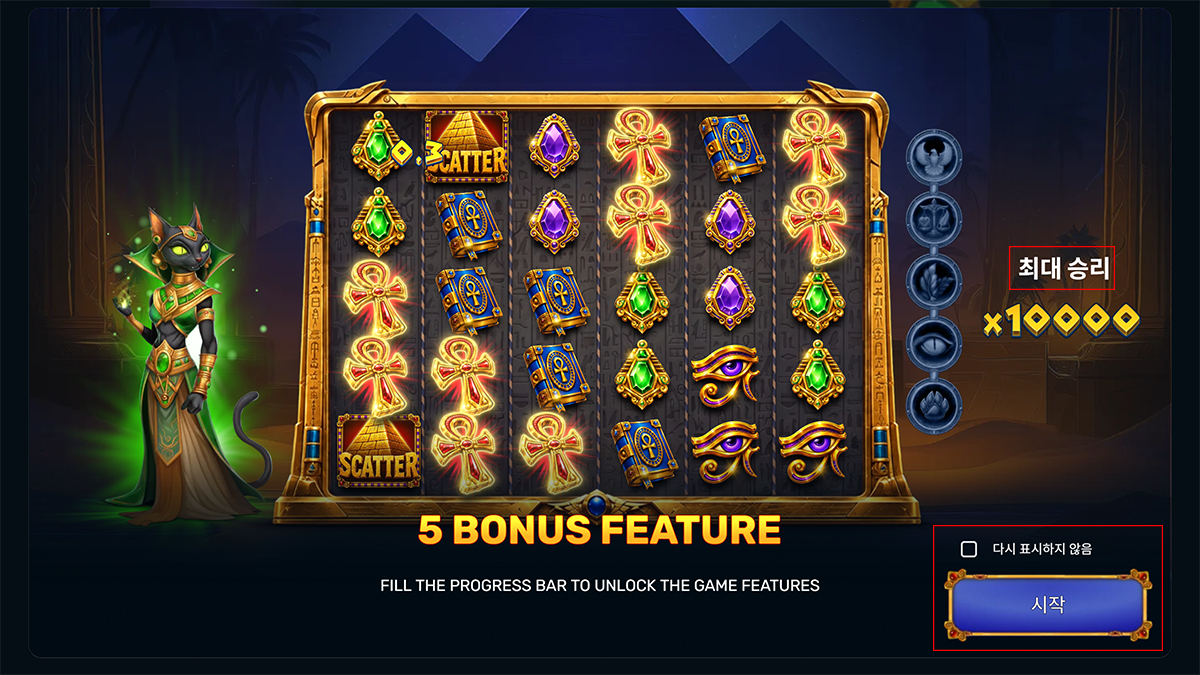
The entry screen translates the maximum win label, “Do not show again,” and “Start” into Korean. Yet “5 BONUS FEATURE” and “FILL THE PROGRESS BAR TO UNLOCK THE GAME FEATURES” remain in English at the center. The latter tells players to fill the progress bar to unlock game features, making it information needed to understand the game.
The controls and settings are localized, while the central feature introduction is not. Korean-speaking players can start the game, but must read English to understand how its features are unlocked.
Main Screen: Missing Translation and Unsuitable Monetary Terminology
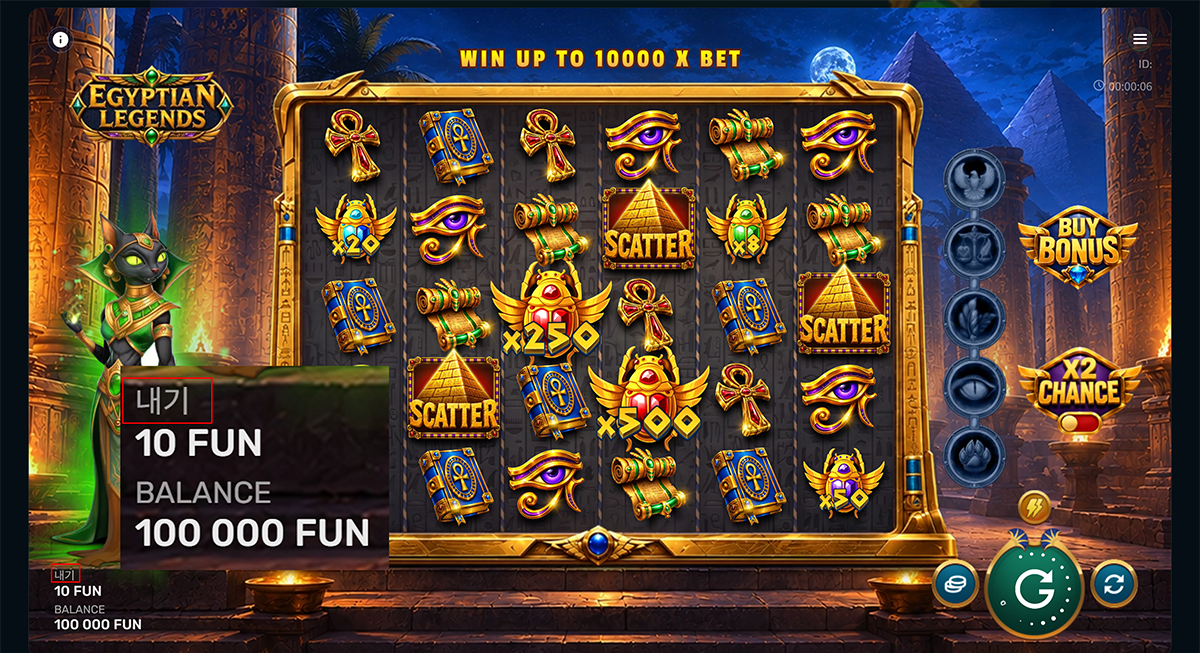
In the lower-left HUD of the main screen, BET is translated as “내기,” while BALANCE immediately below remains in English. Even these two basic monetary labels—the bet amount and the balance—do not share a consistent language.
“내기” is an everyday Korean word for a wager or a contest involving stakes, but this field displays the amount set for a single spin. “베팅 금액” (“Bet amount”) would describe its function more clearly. The problem is both an untranslated label and a translated term that does not fit its UI context, leaving players to interpret English alongside awkward Korean.
Rules: Two Languages Within the Same Document
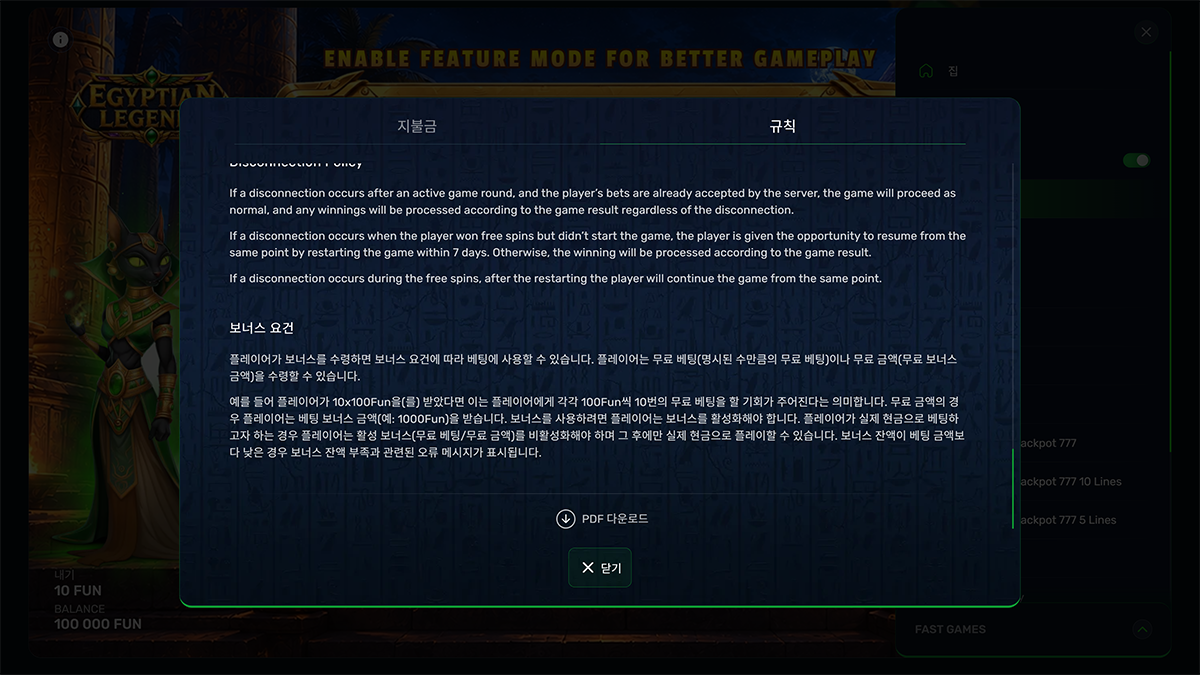
The rules window displays Korean labels for the paytable, rules, PDF download, and Close. Within the body, “Bonus requirements” and its explanation are in Korean, but “Disconnection Policy” and the paragraphs immediately above remain in English. Translation coverage changes from one section to the next within the same document.
The English paragraphs explain how accepted bets and winnings are handled after a disconnection and under what conditions free spins can resume. These rules directly concern monetary handling and continuation of play, making comprehension more important than for promotional copy. Opening a Korean rules window does not provide access to all of its information in Korean.
Analysis
Across all three screens, Korean coverage does not align with the importance of the information to players. Buttons and some labels are translated, while feature instructions and disconnection rules are omitted. Possible causes include incomplete string inventories, separate handling of artwork and UI strings, or rule updates not carried through to every language. The screenshots alone cannot establish the internal cause.
Because the rules window mixes Korean and English paragraphs, the issue cannot be explained solely by text embedded in artwork. The HUD’s “내기” also shows that coverage checks must be accompanied by contextual terminology review. QA needs to assess whether a Korean-speaking player can understand the experience consistently, from entry to consulting the rules, rather than merely confirming that translation resources exist.
Possible Solutions
Inventory all player-facing copy across the entry screen, main HUD, feature controls, and rules, then check that each locale covers the full inventory. Prioritize rules concerning bets and winnings, including disconnection handling. Instructions embedded in artwork should use replaceable text layers or localized image assets.
For the Korean HUD, use clear labels such as “베팅 금액” for BET and “잔액” for BALANCE, with consistent terminology in the rules and feature explanations. Native-language reviewers should assess translated text on the actual screens to catch dictionary-based choices that do not work in context.
Review the full player journey, from entry through gameplay to help and rules. Check desktop and mobile layouts for remaining English, clipped text, line breaks, and reading order. When rules or features change, ensure that the update reaches every supported language.
Scope of the Issue
The directly observed examples are the Korean entry screen, main HUD, and rules window of Egyptian Legends. These observations do not establish that the same problems occur in other games or languages.
However, inventory coverage and complete propagation of updates are localization-wide management concerns. If the same resources or document workflow serve multiple languages, coverage should be checked in each locale. Translating BET as “내기” is a Korean terminology issue that requires contextual review separately from checking for untranslated English.
Potential Risks
Partial localization creates an expectation of Korean support without providing all the information needed to understand the game. Players encounter English feature instructions at entry, mixed and awkward labels during play, and untranslated clauses when consulting the rules. This can make the localization feel more unfinished than a consistently original-language screen.
Failure to understand the disconnection policy can lead to misunderstandings and support inquiries about how bets or winnings are processed and how free spins resume. The risk extends beyond first impressions to players’ understanding of their own game outcomes.
Inconsistency in basic visible information can also weaken confidence in the game’s overall QA. Translation problems do not demonstrate defects in the RNG or win handling, but they can make it harder for players to develop trust in those systems.